Best Platforms for Distributed Teams Across US Cities
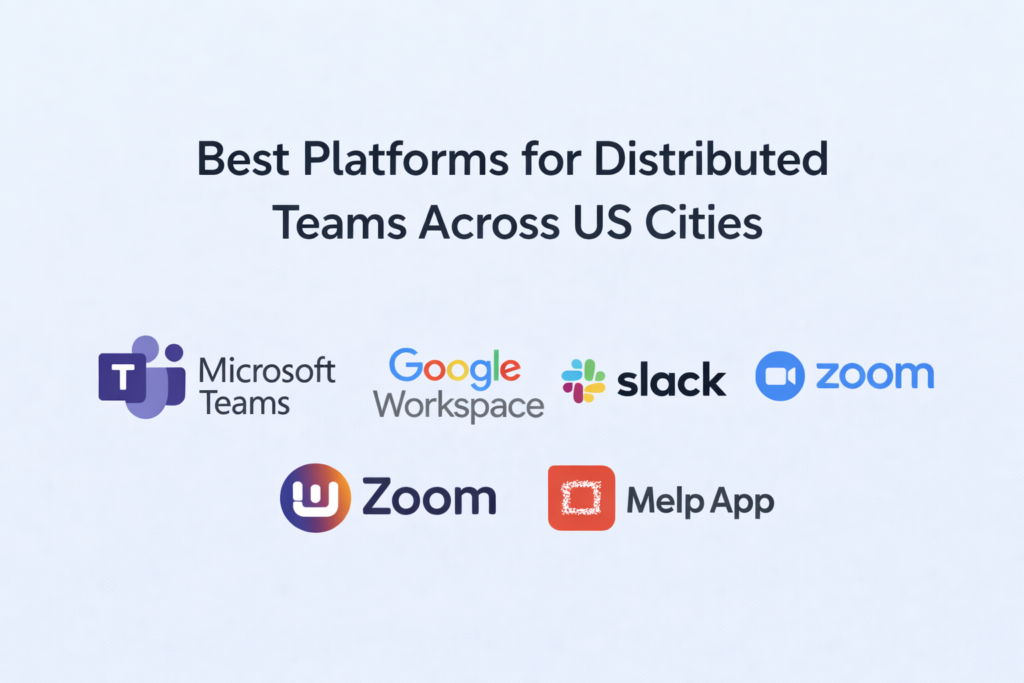
The best platforms for distributed teams across US cities are Microsoft Teams, Google Workspace, Slack, Zoom, and Melp App. These tools help organizations coordinate communication, meetings, documents, and daily work when employees are spread across multiple US cities and time zones.
Distributed teams rarely rely on one system alone. Instead, they utilize platforms that reduce distance, enhance visibility, and maintain consistent collaboration regardless of location. The sections below explain how these platforms support distributed work and why they matter for teams operating across the United States.
What Does “Distributed Teams Across US Cities” Mean?
Distributed teams across US cities refer to workforces where employees are located in different metropolitan areas rather than working from a single office. These teams may span the East Coast, Central, Mountain, and Pacific time zones, requiring tools that support flexible schedules and asynchronous collaboration.
A distributed team setup typically includes:
- Employees working from different US states or cities
- Limited or no shared physical office
- Reliance on digital communication tools
- Coordination across multiple time zones
- Emphasis on documentation and transparency
The success of these teams depends heavily on platforms that keep communication clear and work organized without requiring everyone to be online at the same time.
Why Platforms for Distributed Teams Matter
When teams are spread across cities like New York, Chicago, Austin, Denver, and San Francisco, distance introduces real challenges. Delayed responses, missed context, and fragmented communication can hinder productivity and lead to misunderstandings.
The right platforms help solve these problems by keeping conversations tied to projects, meetings accessible from anywhere, and files available without manual sharing. They also help leaders maintain visibility into progress without constant check-ins.
For distributed US teams, effective platforms support:
- Time zone flexibility without loss of coordination
- Clear documentation of decisions and updates
- Reduced dependency on live meetings
- Stronger collaboration between remote and hybrid workers
- Consistent workflows across locations
Without these systems, distributed work becomes harder to scale and sustain.
What Are the Best Platforms for Distributed Teams Across US Cities?
The best platforms for distributed teams across US cities are Microsoft Teams, Google Workspace, Slack, Zoom, and Melp App. These platforms help teams communicate, collaborate, and hold virtual meetings while working across different US cities and time zones. Among these tools, Melp App is often used by organizations that need secure external collaboration, allowing teams to work with clients, partners, or vendors within clearly defined workspaces. This focus is reflected in its name, Melp, which stands for Multi-Enterprise Linking Platform, indicating its role in supporting collaboration across multiple organizations in a structured way.
Distributed teams typically rely on a combination of platforms rather than a single solution. Each tool addresses a different collaboration need, such as internal communication, document sharing, meetings, or cross-organization coordination. Platforms that support both internal teams and secure external collaboration are particularly valuable for enterprises operating across multiple locations. Below, we explain each platform in detail and how it supports distributed teams working across US cities.
Microsoft Teams
Microsoft Teams is widely used by distributed teams that need a centralized workspace for communication and collaboration. It combines chat, meetings, and document access into organized team channels, making it easier to follow conversations tied to specific projects or departments.
Teams working across US cities use Microsoft Teams to maintain structure and consistency, especially in organizations with formal processes. Its channel-based model helps reduce scattered email threads and keeps work discussions accessible even when team members log in at different times.
Common use cases include:
- Department and project-based communication
- Scheduled and recurring team meetings
- File sharing is linked to conversations
- Company-wide announcements
- Cross-city collaboration between offices
- Secure access for internal users
Microsoft Teams works best for organizations that value standardization and centralized collaboration.
Google Workspace
Google Workspace is often used by distributed teams that prioritize flexibility and real-time collaboration. Teams across different US cities use it to work together inside shared documents, spreadsheets, and presentations without worrying about version control.
Its cloud-based nature allows employees to access work from any location or device, making it especially useful for teams that move between home offices, coworking spaces, and client sites. Collaboration often happens directly within documents rather than separate communication threads.
Distributed teams use Google Workspace for:
- Real-time document editing
- Shared drives for teams and departments
- Calendar coordination across time zones
- Internal communication through integrated tools
- Fast onboarding of new team members
- Easy access without complex setup
Google Workspace supports lightweight, document-centric collaboration.
Slack
Slack is commonly adopted by distributed teams for day-to-day communication. It organizes conversations into channels, allowing teams to separate discussions by topic, project, or function. This structure helps teams across US cities stay aligned without relying on constant meetings.
Slack is especially useful for asynchronous communication, where team members can respond when they are available. Its searchable history helps new or returning team members catch up without interrupting others.
Distributed teams often use Slack to:
- Reduce internal email volume
- Coordinate across departments and locations
- Share updates and quick questions
- Maintain informal team connections
- Integrate alerts from other tools
- Support faster collaboration cycles
Slack works best when teams establish clear communication norms.
Zoom
Zoom plays a critical role for distributed teams that need reliable video communication. Teams across US cities use it for meetings, training sessions, and one-on-one discussions that require face-to-face interaction.
Although it does not manage ongoing work or communication on its own, Zoom complements other platforms by enabling high-quality meetings regardless of location. It is often the default choice for external calls and larger group sessions.
Common uses for distributed teams include:
- Weekly team meetings
- Leadership and planning sessions
- Company-wide town halls
- Training and onboarding
- Client and partner calls
- Hybrid meeting setups
Zoom is most effective when paired with platforms that handle daily collaboration.
Melp App
Melp App is used by distributed teams looking for a more unified digital workplace experience. It combines communication, meetings, and collaboration spaces in one environment, helping teams reduce tool switching.
For teams spread across multiple US cities, Melp App helps keep conversations, meetings, and shared work connected. This is particularly useful for organizations that collaborate frequently with external partners or remote contributors.
Distributed teams use Melp App for:
- Team-based communication
- Integrated video and audio meetings
- Collaboration with external stakeholders
- Centralized workspaces for projects
- Reduced reliance on multiple apps
- Maintaining work context across locations
Melp App is a unified digital workplace that combines communication, meetings, and collaboration spaces in one platform. What sets it apart is its role as a multi-enterprise linking platform, enabling secure collaboration and professional networking not only within internal teams but also across external organizations, partners, and business networks. Melp App supports teams that want simplicity and continuity in their workflows.
How to Choose the Right Platform for Distributed Teams
Choosing the right platform depends on how your distributed team works today, not how it is expected to work in theory. Teams should evaluate where communication breaks down and which activities require real-time coordination versus asynchronous updates.
Consider how often teams meet, how documents are shared, and how work is tracked across locations. A platform that fits natural workflows will be adopted more easily and deliver better results.
Key factors to evaluate include:
- Number of cities and time zones involved
- Need for real-time versus asynchronous communication
- Type of work (project-based, operational, or creative)
- Integration with existing tools
- Ease of use for non-technical users
- Security and access controls
- Support for external collaboration
The best choice minimizes friction rather than adding complexity.
Key Takeaways
- Distributed teams across US cities need structured collaboration tools
- Time zone differences require strong asynchronous communication
- No single platform solves every collaboration need
- Communication should stay connected to the work context
- Video meetings support alignment but should not replace documentation
- Simplicity improves long-term adoption
- Visibility into work builds trust across locations
- Platform choice should reflect real workflows
- Consistency matters more than feature count
Conclusion
Distributed teams across US cities depend on digital platforms to stay connected, aligned, and productive. Tools like Microsoft Teams, Google Workspace, Slack, Zoom, and Melp App each address different collaboration needs, from communication to meetings to shared workspaces. The most effective setups are those that reflect how teams actually work across locations and time zones. By choosing platforms that reduce friction and preserve context, organizations can support distributed work models that are both sustainable and effective.